Wednesday, November 2, 2011

Halloween Candy Buy-Back!


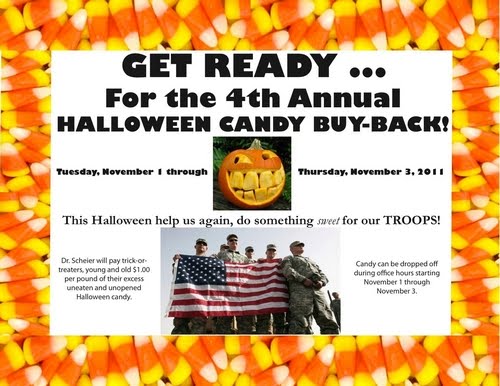
It's November, and everyone is packing up their Halloween costumes and decorations...But, don't forget that Dr. Scheier's 4th Annual Halloween Candy Buy-Back is going on right now in our office!

Dr. Mitchell Scheier will pay trick-or-treaters, mothers, fathers, grandparents and/or guardians $1.00 per pound of their excess uneaten and unopened Halloween candy. Last year our office collected almost 1,000 pounds of candy, and we want to exceed that amount this year! If you drop off your candy, you will receive a goody bag to help keep your teeth clean and sugar-free. You may also enter our raffle for a chance to win a new iPod Nano!

All of the Halloween candy collected will be shipped to our troops overseas and right here at home, providing them a sweet treat as a thank you for their service. Feel free to leave a note, drawing, prayer, or poem with your Halloween candy to be shipped to our troops.

Candy drop off began on Monday, and it ends tomorrow, November 3rd! Thank you in advance for helping us support this wonderful cause!

Tuesday, October 25, 2011

4th Annual Halloween Candy Buy-Back!

Halloween and trick-or-treating are right around the corner and you know what that means...lots of CANDY! Our team at Dr. Mitchell Scheier's office is excited to announce our 4th Annual Halloween Candy Buy-Back! Stop by our office from November 1st until November 3rd to sell us your leftover Halloween candy. Dr. Scheier will pay you $1.00 per pound of uneaten and unopened candy that you bring to our office.

You can drop your candy off during our regular office hours. All of the candy that we receive will be shipped to our troops overseas. Help us do something sweet for our troops!

Tuesday, October 18, 2011

Ask Dr. Scheier: What's so bad about nail biting?

We’ve all heard that biting your nails is an awful habit, but you many wonder- really- what’s so bad about it? Recently, Dr. Mitchell Scheier found an interesting article that discusses how biting your nails affect your teeth and oral health.

Nail biting, also known as Onychophagia, is a common habit among various age groups, including primarily children, teens and young adults. Nail biting is generally triggered by stress and most often decreases with age. That being said, nail biting is unsanitary, unattractive, as well as unhealthy for your teeth!

Here’s why:
It’s unsanitary. Your nails are dirty, almost twice as dirty as your fingers! Hence, biting your nails is just asking for germs and bacteria.
No good things come to your teeth. Nail biting causes your teeth to constantly be chewing, which is not good for them. This excessive motion wears your teeth down faster than a non-nail biter’s and puts a large amount of stress on your front teeth- contributing to teeth misalignment.
Braces don’t love it either. Braces already put pressure on teeth, nail biting ads unnecessary pressure, further stressing your teeth and weakening their roots.
It can be costly. Nail biting can result in up to $4,000 in additional dental bills over one lifetime, according to the Academy of General Dentistry (AGD). Yikes!

What can you do about it?
Now that you know how harmful nail biting can be, it’s time to take action to break your nail biting habit. Try to be conscious of your fingernails and to keep them looking good- this will help you resist the temptation. Ask Dr. Scheier or visit the article for tips on how to break a nail biting habit.

Good luck!

Dr. Mitchelle Scheier and staff

Wednesday, October 12, 2011

Artificial sweeteners and your child's health

Dr. Mitchell Scheier knows that there is always a lot of debate in the health community about the health effects of artificial sweeteners, and aspartame is most surely one of the most controversial food additives to ever be approved by the FDA. Dr. Scheier and his team will try to provide you with the most up to date information on topics relating to the health of our patients and their loved ones. That is why we want to share with you a few facts that we recently learned in a Huffington Post article.

Did you know that aspartame is now sold under many commercial names, including NutraSweet, Canderel, and AminoSweet? Yes, that’s right. When checking nutrition facts, it is important to keep an eye out for all of these ingredients! This sweetener can be found in diabetic foods, jams, breakfast cereals, chewing gum, soda, and even prescriptions and vitamins.

What’s so harmful about aspartame?
With over 10,000 official complaints, aspartame reactions are more commonly reported than that of all other food additives combined. Of these reports, two-thirds consist primarily of headaches, mood alterations, and hallucinations. Determining your nutritional type and the foods that your body craves is key to satisfying sugar cravings. The recommended fructose level is below 25 grams per day, which includes both natural and artificial sweeteners.

Next time you're in for an appointment with Dr. Scheier, let us know if you have any questions about aspartame or this article. As always, please remember to use a straw if you choose to sip soda, coffee, or other dark colored beverages to take care of that beautiful smile!

Wednesday, October 5, 2011

Smile! October is National Dental Hygiene Month!

Did you know that October is National Dental Health Month? For our staff at Dr. Mitchell Scheier Family and Cosmetic Dentistry, that means only one thing: Reminding you that your teeth are an important part of your body, and keeping them clean helps keep your mouth and your body healthy. By taking care of your teeth, eating a balanced diet and visiting our convenient Havertown office on a regular basis, you can have healthy teeth and an attractive smile throughout your entire life.

We encourage you to check out the official National Dental Hygiene Month website as well, which provides pointers on keeping your mouth clean and healthy. Lastly, has it been six months since your last visit to Dr. Mitchell Scheier Family and Cosmetic Dentistry? If the answer is yes, we encourage you to give us a call to set up an appointment with Dr. Scheier.

Wednesday, September 28, 2011

Five great snacks for kids


At Dr. Mitchell Scheier's office, we know getting kids and teens to eat healthy isn’t always an easy task, especially when they’re busy with school and other school- and social-related activities. At the school cafeteria, it's just too easy for kids to nosh on french fries, chicken nuggets and other fried foods and unhealthy snacks, so Dr. Scheier and our team thought we’d pass along five delicious and nutritious snacks we know your child will love.

1. Cheese – Cheese is one of the healthiest snacks for your child's teeth. In addition to providing large amounts of much-needed calcium, cheese also does its part to fight cavities. Cheese stimulates the body's salivary glands to clear the mouth of debris and protect them from acids that weaken them, according to the American Academy of Pediatric Dentistry. This means cheese disrupts the development of cavities, especially when eaten as a snack or at the end of a meal. Calcium and phosphorous found in cheese reduce or prevent decreases in the plaque's ph level and work to re-mineralize the enamel of your child's teeth.

2. Blueberries These tiny nutritional powerhouses are loaded with Vitamin C, as well as folic acid, minerals, fiber and disease-fighting phytochemicals, which have shown to help prevent cancer and diabetes. Kids love them sprinkled with a bit of sugar, topped with whipped cream, added to muffins and pancakes.

3. Whole wheat bread or cereal With bread, kids get their iron, vitamins, magnesium, and zinc. With vitamins, calcium, and fiber, a bowl of enriched whole grain cereal with milk—and even fruit—is a power-packed snack or healthy start to the day.

4. Almonds They’re rich in disease-fighting phytochemicals and Vitamin E, and also have good amounts of fiber, iron, and calcium. Let your kids eat them raw. (Note: Whole nuts are a choking hazard for children under 3 years old.)

5. Yogurt Eating dairy is not just healthy for building strong bones, but is essential for maintaining a strong, healthy mouth. Low-fat yogurt is an excellent source of calcium, especially when whipped up in a parfait with berries and granola. Homemade fruity yogurt pop sure beats sugary store-bought frozen treats!

We encourage you to check out the other 15 healthy snacks your child can enjoy at any time of the day! For more information about which foods are best for keeping your teeth healthy, please post your question here on our blog, give us a call or ask us on Facebook!

Thursday, September 22, 2011

Manual vs. Electric Toothbrushes: What’s the Difference?


Everybody is jumping on the electric toothbrush bandwagon in recent years, with many experts in the dental field claiming electric toothbrushes provide superior dental care. It’s true that electric toothbrushes are recommended for those who can’t do a good job brushing manually or who have arthritis or other conditions. But manual toothbrushes do have some advantages, according to an article we recently found including:

• Cost. While electric toothbrushes may be expensive for many people, manual toothbrushes are both inexpensive and accessible.

• Less pressure on your teeth & gums. While we can feel the amount of pressure we’re using as we grasp our manual toothbrush, we can’t feel the pressure nearly as well with an electric toothbrush. Placing too much pressure on our teeth can wear away at the tooth enamel, which causes pain, sensitivity, as well as an increased risk of tooth decay.

• Simple to pack. Manual toothbrushes are easy to carry around for those business or family trips. People are less likely to let their good dental care habits lapse on vacation with a toothbrush that they can easily bring along!

• Better for kids. Learning at a young age how to properly use a manual toothbrush helps children get a feel for how to properly take care of their oral hygiene.

Electric toothbrushes, on the other hand, are more effective in removing plaque and are considered a better alternative to maintaining gum health. Remember, whether you choose a manual or an electric toothbrush, Dr. Mitchell Scheier and our team encourage you to choose one with soft bristles and be sure to change the bristles on the electric brush when they become worn down. We also encourage you to replace your toothbrush every three months, when the bristles are no longer straight and firm or after you recover from a cold.

Give us a call at Dr. Scheier's office if you have any questions or ask us on Facebook!

Happy brushing!